
by Kimberly Hughes, Center Director
Artificial intelligence is no longer a future issue for teacher education. It is already part of the daily work of many faculty members preparing the next generation of science and mathematics teachers.
In a recent National Center for STEM Education study of faculty, administrators, and staff at UTeach secondary STEM education preparation programs in 31 universities across the United States, nearly all respondents reported using AI in some capacity, and almost four out of five instructors already address AI in the courses they teach.
The findings reveal a field that recognizes AI's enormous potential but remains fragmented in its application, with deep concerns about its risks. There is a growing consensus that AI should be used thoughtfully, with strong attention to ethics, critical thinking, and educational quality.
Cautious Optimism
One of the report's clearest findings is that educators are far more optimistic than one might expect.
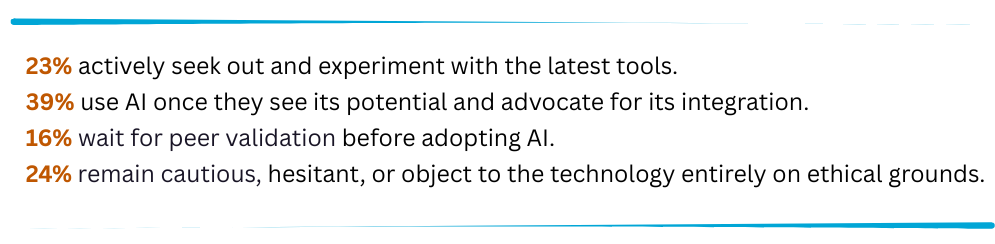
More than three-quarters of respondents believe AI has the potential to positively impact their work preparing future teachers, while 61% describe themselves as proactive adopters of AI technologies. In fact, nearly two-thirds fall into the categories of "innovators" or "early adopters" who either actively explore new tools or advocate for their use.
Rather than rejecting AI outright, most educators who prepare future STEM teachers appear willing to experiment. For many, the question is no longer whether AI belongs in teacher preparation, but how it can be used responsibly and effectively.
Moving Beyond Chatbots and Productivity Tools
The survey shows that educators are using AI for far more than simple text generation. Faculty members report using AI to create instructional content, support research, automate administrative tasks, generate feedback, and analyze educational data. Many are also introducing future teachers to the technology within their coursework.
Perhaps most noteworthy is that many instructors are beginning to use AI for pedagogical design. Rather than simply asking AI to generate content, they use it to help develop lesson plans, refine project-based learning experiences, create assessments, and support differentiated instruction. More advanced users are even incorporating AI-supported data analysis, inquiry activities, and STEM-focused investigations.
This suggests that teacher educators are increasingly viewing AI not as a shortcut, but as a professional tool that can support stronger teaching and learning.
Personalized Learning Is the Biggest Opportunity
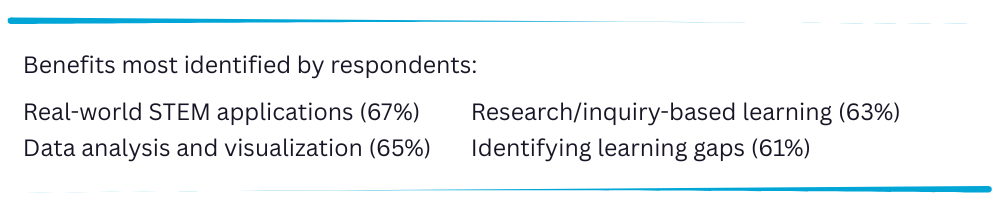
When asked where AI could make the greatest difference with regard to middle and high school STEM classrooms, respondents overwhelmingly pointed to personalization. More than 80% believe AI can help tailor instruction to individual student needs. Educators also identified significant opportunities for AI to support real-world STEM applications, data analysis and visualization, inquiry-based learning, and the identification of learning gaps.
These findings are particularly important because STEM education often requires helping students work through complex concepts at different paces. AI-powered tools could provide personalized practice, immediate feedback, and customized learning experiences that are difficult for teachers to deliver at scale.
Respondents also saw major benefits for teacher preparation itself. Supporting teacher candidates in lesson planning was identified as the single most valuable application, followed by streamlining administrative work, improving programs through data analysis, and providing better coaching for teacher candidates.
Serious Concerns Remain
Despite the optimism, the report makes clear that educators are not ignoring AI's potential downsides. Nearly two-thirds of respondents expressed moderate or high concern regarding the expansion of AI in teacher preparation. The largest concern centered on academic integrity and the fear that AI could weaken deep thinking and authentic learning. Many worry that students may increasingly rely on AI-generated answers instead of developing their own understanding.
Other concerns include algorithmic bias, environmental costs, inaccurate or fabricated information (AI hallucinations), loss of human connection in teaching, and questions about student data privacy. Respondents repeatedly emphasized that effective teaching depends on human judgment, relationships, and nuanced decision-making that technology cannot replace.
Educators see tremendous promise in AI, but they want assurance that it will strengthen rather than undermine educational quality.
The Biggest Need: Learning From One Another
One of the report's findings is that educators are not primarily asking for formal training. Instead, they want opportunities to learn from and with colleagues who are already experimenting with AI in meaningful ways. Seventy percent of respondents expressed a desire for additional support, with peer-to-peer learning, collaborative communities, practical demonstrations, and shared resources emerging as top priorities. They also want clarity on AI-related policy and data-backed evidence of AI’s efficacy.
Educators do not want abstract discussions about AI. They want relevant examples, evidence, and practical strategies that can be applied specifically to STEM teacher preparation.
The Road Ahead
Perhaps the most important conclusion of the report is that STEM teacher educators are not starting from scratch. Across the country, faculty are already experimenting with AI and discovering promising applications. What is missing is a shared framework for responsible implementation.
The report argues that the future of AI in teacher preparation should focus on three priorities: leveraging AI to support high-impact STEM learning, mitigating risks related to academic integrity and equity, and building communities of practice that help educators learn from one another and provide sustained implementation support.
The challenge ahead is not whether AI will become part of teacher preparation. That process is already underway. The real question is whether educators can shape its use in ways that preserve critical thinking, protect the human elements of teaching, and expand opportunities for students to engage deeply with STEM learning.
Subscribe to our newsletter for updates on our work and how to get involved.